
Overview
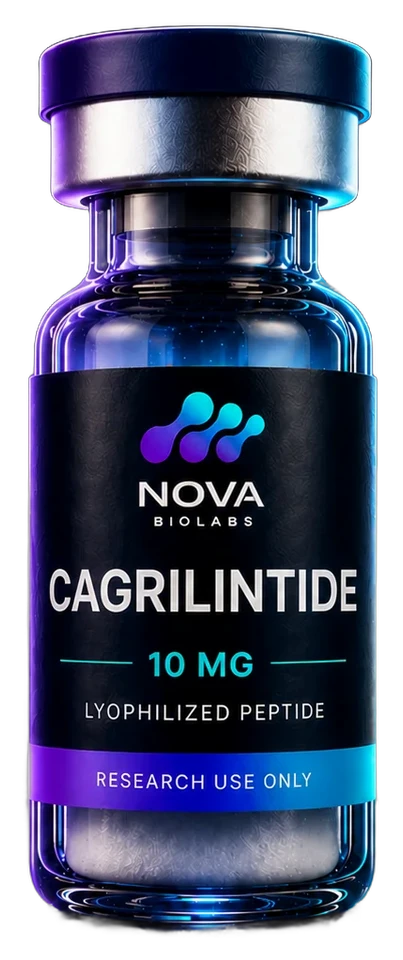
Cagrilintide is a long-acting amylin receptor agonist — an acylated analogue of human amylin, the hormone co-secreted with insulin by pancreatic beta cells. The fatty acid modification promotes albumin binding, extending its half-life and supporting once-weekly dosing schedules in research protocols, using the same acylation approach seen in long-acting GLP-1 analogues.
Unlike GLP-1 receptor agonists such as semaglutide or tirzepatide, Cagrilintide acts on amylin receptors, engaging a distinct but complementary signalling pathway relevant to appetite regulation and gastric emptying research. It is frequently studied in combination with GLP-1 receptor agonists to investigate additive or synergistic effects across the two pathways.
Nova Biolabs supplies Cagrilintide 10mg in lyophilised form from UK domestic stock.
Key Research Areas
Amylin Receptor Signalling
Cagrilintide's design as a stable, long-acting amylin analogue makes it a useful tool for studying amylin receptor activation independently of GLP-1 pathway involvement.
Gastric Emptying Research
Amylin signalling is studied for its role in slowing gastric emptying, a mechanism relevant to satiety and post-prandial glucose research models.
Combined GLP-1 / Amylin Pathway Studies
Cagrilintide is widely investigated alongside GLP-1 receptor agonists to explore whether dual-pathway engagement produces additive effects in appetite regulation research.
Acylation & Half-Life Research
As an acylated peptide, Cagrilintide is a relevant reference compound for pharmacokinetic and albumin-binding research within long-acting peptide design.
Product Specifications
| Format | Lyophilised powder |
| Quantity | 10mg per vial |
| Grade | Research Grade |
| Storage | Refrigerate at 2–8°C, protected from light. Stable 24 months lyophilised. |
| Origin | UK domestic stock |
| Research use | In vitro / laboratory use only |
Frequently Asked Questions
Commonly Stacked With
Compounds researchers often study alongside this one, and why.

Amylin and GLP-1 receptor pathways are frequently studied together — Cagrilintide is often paired with a GLP-1 agonist for combined appetite-signalling research.

Combined amylin/incretin receptor research is an active area — often studied alongside dual-agonist compounds like Tirzepatide.
Amylin-pathway research is studied alongside triple-agonist compounds for the broadest combined appetite/metabolic signalling coverage.