
Overview
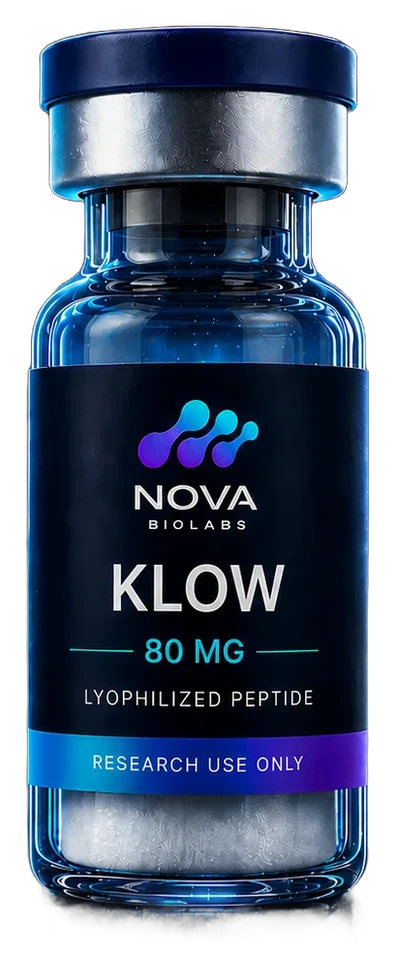
KLOW is Nova Biolabs' most advanced blend — it builds directly on our GLOW formula (GHK-Cu, BPC-157, TB-500) by adding a fourth peptide, KPV, a tripeptide fragment of alpha-MSH studied for anti-inflammatory and gut-barrier research. Where GLOW's research focus centres on skin, collagen and tissue-repair signalling, KLOW extends that profile into anti-inflammatory territory, making it the broader of the two blends.
Nova Biolabs supplies KLOW as a pre-blended lyophilised 80mg vial from UK domestic stock.
KLOW vs GLOW — what's actually different
If you're deciding between the two, this is the honest comparison — not every research need requires the more expensive option.
| GLOW | KLOW | |
|---|---|---|
| Composition | GHK-Cu + BPC-157 + TB-500 | GHK-Cu + BPC-157 + TB-500 + KPV |
| Vial size | 70mg | 80mg |
| Price | £50.00 | £70.00 |
| Additional research focus | — | Anti-inflammatory / gut-barrier (via KPV) |
| Published dosing reference | Yes — see GLOW page | Not yet published |
If your research doesn't need the anti-inflammatory-focused fourth peptide, GLOW is the simpler and cheaper starting point. KLOW is worth the difference specifically if that additional research angle is relevant to what you're studying — not by default.
Key Research Areas
Anti-Inflammatory Research
KPV is studied for anti-inflammatory signalling, including in gut-barrier and colitis research models.
Skin & Collagen Research
GHK-Cu is studied for its role in extracellular matrix remodelling and collagen-related signalling.
Tissue Repair Research
BPC-157 and TB-500 are independently studied for effects on tissue healing signalling across various models.
Combined Regenerative Signalling
The four-peptide combination is studied for potential complementary effects spanning repair, remodelling and inflammatory-pathway research.
Product Specifications
| Format | Lyophilised powder blend |
| Composition | GHK-Cu + BPC-157 + TB-500 + KPV, blended |
| Vial size | 80mg |
| Grade | Research Grade |
| Storage | Refrigerate at 2–8°C. Stable 24 months lyophilised. |
| Origin | UK domestic stock |
| Research use | In vitro / laboratory use only |
Reconstitution & Dosing
We have not published a specific phased dosing reference for KLOW the way we have for GLOW — KLOW is a newer addition and we'd rather say that plainly than guess at numbers we haven't verified. Use our dosing calculator and reconstitution guide for the mixing and syringe-draw maths, and cross-reference independent published research for protocol guidance specific to KPV and the combined blend.
Frequently Asked Questions
Commonly Stacked With
Compounds researchers often study alongside this one, and why.
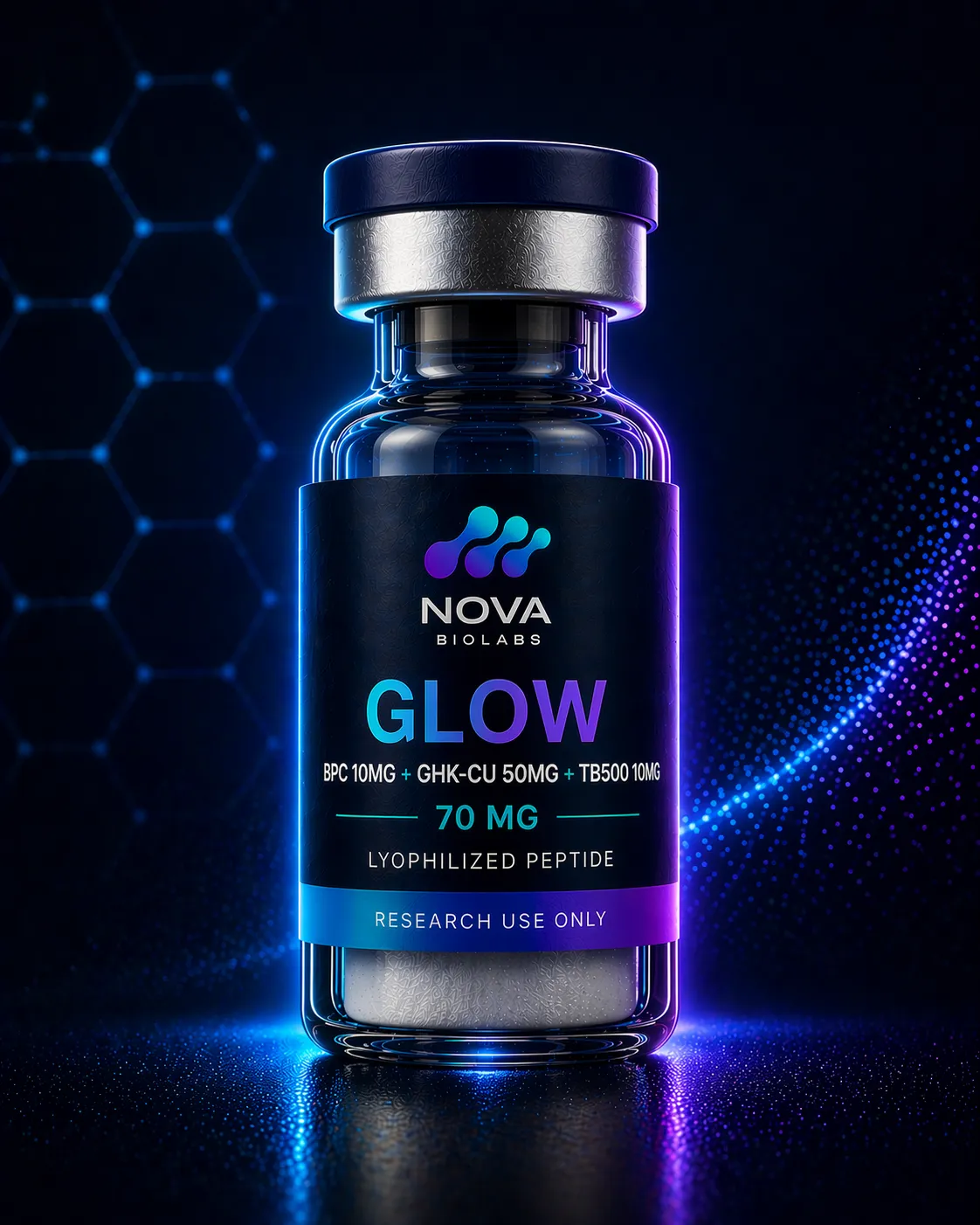
GLOW shares three of KLOW’s four compounds — useful for isolating the added KPV component’s contribution in comparative studies.

The core three-compound foundation KLOW is built on, plus KPV — useful for isolating each component’s contribution.

GHK-Cu is frequently studied alongside BPC-157/TB-500 for comprehensive tissue-repair and regenerative signalling research.